 |
|

 |

Monday, June 13, 2016
Diplomado online en Liderazgo y gestión pública local

Friday, June 10, 2016
an Algorithm Wants Your Job. Now What? (BW)

On Wall Street, the still-essential business of banking will go on—but maybe without as many suits.
Are the humans of finance an endangered species?
People are still the lubricant that oils the wheels of finance, toiling at innumerable tasks—executing and settling trades, writing analysis, monitoring risk. That’s about to change.
Squeezed by low interest rates, shrinking trading revenue, and nimbler technology-based competitors, banks are racing to remake themselves as digital companies to cut costs and better serve clients. In other words, they’re preparing for the day that machines made by men and women take over more of what used to be the sole province of humans: knowledge work. Call it self-disruption.
Consider venerable State Street, a 224-year-old custody bank that predates the steam locomotive and caters to institutional investors such as pensions and mutual funds. In February, State Street executives told analysts that after spending five years upgrading technology systems, they realized how much more could be done. “We have 20,000 manual interventions on trades every day,” said Michael Rogers, president of the Boston bank. “There’s a huge opportunity to digitize that and move it forward electronically.”
But one person’s opportunity is another person’s exit package. State Street had 32,356 people on the payroll last year. About one of every five will be automated out of a job by 2020, according to Rogers. What the bank is doing presages broader changes about to sweep across the industry. A report in March by Citigroup, the fourth-biggest U.S. bank, said that more than 1.8 million U.S. and European bank workers could lose their jobs within 10 years.
Advances in cloud-based computing and algorithms capable of combing vast amounts of data for decision-aiding patterns make this possible. The human brain is a wondrous machine, but it isn’t changing. The pace of technological advancement is accelerating, and artificial intelligence (AI) may one day make many forms of work extinct. It’s a topic that’s dominated forums such as the Milken Institute Global Conference in May and has spurred talk of government-funded universal basic income programs that would pay citizens a regular stipend.
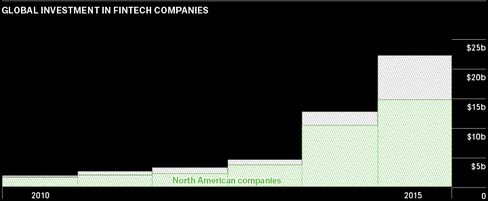
All of that’s a ways off. What concerns bankers today—the ones who’ve survived round after round of post-financial crisis job cuts—is how humans will coexist with machines over the next few decades. Maligned in recent popular culture via movies like The Big Short, the still-essential business of banking isn’t getting a breather after new regulations reined in profits and risk-taking. It’s under assault from all sides by fintech startups devising new ways of doing old kinds of banking. From Hong Kong to Dublin, Brooklyn to Dubai, these upstarts attracted $22.3 billion in funding last year, up 75 percent from 2014, according to an Accenture analysis of data from research firm CB Insights.
Bank executives know what’s coming. So they’re setting up coder labs and investing in startups, teaming up with digital competitors or buying them outright. JPMorgan Chase, the biggest U.S. lender by assets, is using AI to identify potential equity clients. And it’s marshaling OnDeck Capital’s client-vetting algorithm to speed lending to small businesses. Both Bank of America and Morgan Stanley, which together employ more than 32,000 human financial advisers, are developing automated robo-advisers. More than 40 global banks have joined forces with startup R3 to develop standards to use blockchain, software that allows assets to be managed and recorded through a distributed ledger, to overhaul how assets are tracked and transferred.
The universal theme of banking’s tech strategy is to make sure that, internally and in dealing with clients, ones and zeros flow seamlessly without messy human interference. At State Street, for example, incompatible systems and a variety of inputs mean people need to manually work an order— some 50,000 of them arrive each month in the form of a telephonically transmitted document that many assume had gone the way of the cassette tape: the fax. Instructions received that way require a human to manually shuttle trade and settlement information between screens. In other instances, missing or mismatched information in complicated trades needs to be reconciled by a person.
Machine learning, where the decision-making power of algorithms improves as more data are raked in, can replace people in some instances, say finance executives including Daniel Pinto, head of JPMorgan’s investment and corporate bank. Algorithms already tackle tasks such as vetting banking clients, pricing assets, and hedging some orders without human intervention. “As we make those processes more and more efficient, you will need less people to do what we do today,” Pinto says.
Beyond that, bots armed with AI and the ability to understand and respond in natural language can be used to answer clients’ queries and eventually execute transactions, says Suresh Kumar, chief information officer of Bank of New York Mellon. “You start with something simple, maybe just offering information, then you start doing transactions,” Kumar says. “We obviously want to automate everything, but you have to prioritize.”
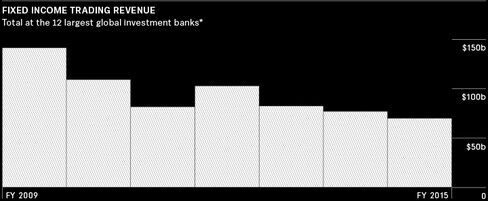
Even those at the top of the industry’s hierarchy aren’t immune. Bond trading is the single biggest source of Wall Street profit. It’s also something of a broken market. Post-crisis regulations have crimped banks’ ability to stockpile bonds, changing their traditional role in markets and creating an opening for dozens of electronic-trading startups looking to connect buyers and sellers. Fixed-income trading at the world’s biggest investment banks brought in $70 billion last year, half the 2009 level, according to data compiled by financial research firm Coalition.
When investors embrace electronic trading, margins collapse while volumes, for a few winners, surge. In equities, electronic trading has decimated the number of salespeople, traders, and floor brokers; it’s also ushered in high-speed trading firms and alternative exchanges like dark pools. These changes are well under way in government bond trading, where technology-powered firms such as Citadel Securities have made inroads, and in foreign exchange, where year-old XTX Markets now ranks as one of the world’s biggest FX firms.
In the $8.16 trillion corporate debt market—the last big refuge for people who trade over the phone—electronic trading of investment-grade bonds grew 25 percent last year, according to Greenwich Associates. MarketAxess, which is one of the biggest electronic venues in credit, clocked a 27 percent surge in trading volume in the first quarter. (Bloomberg LP, the parent company of Bloomberg News, competes with MarketAxess in providing a venue for electronic trading of corporate debt.) Other upstarts, typically founded by Wall Street refugees, have jumped in.
As with other threats, such as e-payments and automated investing, established players aren’t sitting still. They’re opening up electronic venues so institutional clients—who use investment banks for a bundled array of services—have less reason to wander. Goldman Sachs is offering clients access to its proprietary research and analytical tools through web platforms to entice them to do more business with the firm. As banks automate fixed-income trading operations, “they will start making drastic decisions about their trading personnel,” says George Kuznetsov, Coalition’s head of research and analytics.
Even in investment banking, where the human element is central to dealmaking, technology will have an impact. Many parts of the initial public offering process are “ripe for workflow automation,” Goldman Sachs CIO Martin Chavez said in September.
What all of this means is that the number of front-office trading and dealmaking jobs has been in decline since 2007, just before the financial crisis, when it peaked at 64,521. It was 14 percent lower last year at the world’s largest investment banks, according to Coalition. Even if revenues recover because of higher interest rates, improving economies, and a rebound in debt trading, new platforms will simply scale up to the higher volumes without needing many more flesh-and-blood operators. Wall Street has reached peak human.
Saying that an industry is contracting doesn’t mean people won’t be earning a living in finance down the road. Banks will need computer engineers and data scientists—and old-fashioned voice traders to make markets in more bespoke assets such as structured credit. People will be needed to conceive of, create, and maintain new products. Matthew Dixon, an assistant professor of finance at the Illinois Institute of Technology who has studied machine learning, tells aspiring traders to learn computer programming. “The days you could just learn Excel and do some fundamental analysis are over,” Dixon says. “You’re going to be working with larger and larger amounts of data, and you’ll need to know how to use algorithms.”
Wall Street will go on—but maybe without as many suits.
Wednesday, June 8, 2016
Nigeria: Our space program is not an 'ego trip'

Leading the nascent Nigerian space program is one really tough gig.
There is no billion dollar budget. The labs and equipment are far from cutting edge. The agency's museum sits empty.
New challenges lurk around every corner. Yet S. O. Mohammed, director general of the Nigerian National Space Research and Development Agency (NASRDA), is determined to wring scientific achievements out of his shoestring budget.
"We have always said ... the Nigerian space program is not going to be an ego trip," Mohammed told CNNMoney.
"We are not part of the race for the moon, we're not part the race for Mars," he continued. "What we need to look at is using the space program to look at how we can create typical Nigerian solutions to most of our problems."
Mohammed's goals include the ability to locally design and build a satellite by 2018. By 2030, he hopes to launch a satellite from Nigerian territory. After that? He wants to put a man to the moon.
Yet Mohammed faces intense scrutiny. Critics want to know why Nigeria is spending money on a space program when 70% of its citizens live below the poverty line. When the country's economy is facing an imminent recession?
Moreover, what's the point of a moon mission that would launch more than 60 years after Apollo 11?
Mohammed points to the country's three existing satellites as evidence of what can be gained from a national space program. Already, they've helped document regional climate change patterns and update the country's outdated maps.
They've also been useful in tracking the movements of terrorist group Boko Haram in remote areas of the country.
Look no further, he says, than NASRDA's 2,000-member staff. Mohammed recalls that when he started at the agency eight years ago, it boasted just six scientists with PhDs. Now, the number of PhDs on staff has increased to 70, and another 50 employees are studying in pursuit of advanced degrees.
NASRDA has been granted $20 million this financial year to keep operations going, but it needs $65 million more to get its next satellite project off the ground.
Mohammed says the money will be put to good use -- after all, Nigeria is building on the efforts of others.
"We're not reinventing the wheel," he said. "The Nigerian model is a good model for the developing world. We're not starting all over like the U.S. or Russia."
Look no further, he says, than NASRDA's 2,000-member staff. Mohammed recalls that when he started at the agency eight years ago, it boasted just six scientists with PhDs. Now, the number of PhDs on staff has increased to 70, and another 50 employees are studying in pursuit of advanced degrees.
NASRDA has been granted $20 million this financial year to keep operations going, but it needs $65 million more to get its next satellite project off the ground.
Mohammed says the money will be put to good use -- after all, Nigeria is building on the efforts of others.
"We're not reinventing the wheel," he said. "The Nigerian model is a good model for the developing world. We're not starting all over like the U.S. or Russia."
Mohammed's next priority is launching a Synthetic Aperture Radar (SAR) satellite capable of penetrating cloud coverage. The images it produces should help monitor activity in the Gulf of Guinea, which has recently seen a rise in pirate activity.
Mohammed says these projects are about "capacity building" -- advancements that will eventually turn Nigeria into a regional space innovation hub.
Tuesday, June 7, 2016
Advertisers Alleging Kickbacks Spur Battle With Madison Ave

- Media buyers take rebates without telling clients, report says
- One-sided study will cause ‘substantial’ damage, agencies say
Years of simmering ill will in the $600 billion global ad market just broke into open conflict: America’s top advertisers have accused Madison Avenue’s biggest agencies of secretly pocketing rebates from media outlets, with ad firms striking back harshly at what they called a flawed and unproductive attack.
In an eagerly awaited study, a group representing U.S. advertisers accused big ad firms Tuesday of what essentially amounts to receiving kickbacks. Media buyers connected to the world’s biggest ad agencies get rebates when they buy large blocks of ad space -- many of which they neither disclose nor pass along to their clients, according to the study, commissioned by the New York-based Association of National Advertisers.
The 58-page study, performed by investigative firm K2 Intelligence, doesn’t identify ad agencies or clients or lay out the size of rebates the firms allegedly retained. But in general, it said, such rebates ranged from 1.67 percent to 20 percent of aggregate media spending.
The trade group representing the world’s biggest ad agencies quickly fired back, saying the ANA’s "one-sided" study was not only inconclusive but also threatened to wrongly cause “substantial economic damage to all media agencies.”
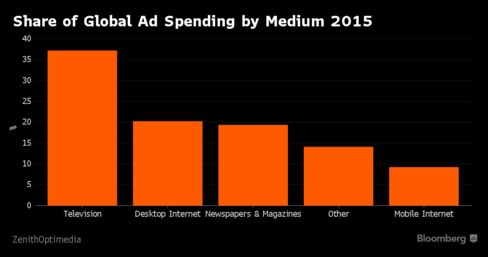
The report casts new light on media buying, a high-margin area of the advertising business. Media-buying arms, often connected with big agencies, purchase blocks of advertising from television, radio, print and other outlets, typically reselling it in multimedia packages for big clients. In the U.S. alone, ad spending across all media totaled $187 billion in 2015, according to research firm Strategy Analytics. Media-buying agency ZenithOptimedia, which is owned by Publicis Groupe SA, estimates global ad expenditure this year at $579 billion.
"There can’t be a client out there that isn’t thinking, ‘Is this happening to me?’ said Judy Neer, president and chief executive officer of Pile & Company, a management consulting firm that specializes in marketing and advertising relationships. “What’s too bad is that those agencies that aren’t doing it are getting dragged into it, and that’s leaving a bad taste in every marketer’s mouth about ad agencies."
Private Matter
While the existence of such rebates has long been acknowledged by the ad industry in the U.S., the subject has generally been treated as a private matter between agencies and their clients. The ANA’s decision to force the issue into the open suggests that a critical mass of advertisers have concerns about what the big agency holding companies are doing with their ad budgets.
“Advertisers and their agencies are lacking ‘full disclosure’ as the cornerstone principle of their media management practices,” said Bob Liodice, president and chief executive officer of the ANA. “Such disclosure is absolutely essential if they are to build trust as the foundation of their relationships with their long-term business partners.”
Advertising is less regulated than some other media businesses, with trade bodies rather than government agencies doing much of the oversight on the major ad agency holding companies such as Publicis, WPP Plc, Omnicom Group Inc., Interpublic Group of Cos., Dentsu Inc. and Havas SA.
Rebates between agencies and vendors are accepted in Europe and many other parts of the world. While the rebates aren’t illegal in the U.S., some of the practices flagged by K2 might not have been consistent with the contracts binding agencies with advertisers, according to the report. Rebates may also pose an accounting challenge for publicly traded ad-agency companies that have to conform to books and records rules consistent with U.S. securities laws.
‘Non-Transparent’ Practices
“Numerous non-transparent business practices, including cash rebates to media agencies, were found to be pervasive” in the digital, print, billboard and television media businesses, according to the ANA.
Those practices included the designation of rebates as "service agreements" in which media companies -- for example, TV outlets or websites -- paid ad agencies for services such as low-value research or consulting activities that were often tied to the volume of the ad agency’s spending.
In other cases where agencies owned their own media inventory, ad agency holding companies directed their buyers to steer their client spending to the in-house media, where markups ranged from 30 percent to 90 percent, the report said.
The ANA, with members including Apple Inc., Wal-Mart Stores Inc. and General Motors Co., commissioned the report last year. For the seven-month study, K2 interviewed 150 individual sources with knowledge of U.S. media buying, ANA said
.
GM said it has worked with its agencies to implement best practices outlined in the study. “While General Motors benefits from the insights derived from the report, we did not underwrite the funding required to create it,” it said through spokesman Craig Daitch. Apple and Wal-Mart didn’t immediately respond to requests for comment.
‘Unverifiable Assertions’
The American Association of Advertising Agencies, or the 4As, said in a statement that it is committed to ensuring that appropriate governance practices are in place. It called on ANA to provide agencies, on a confidential basis, with all of the materials related to them.
“Without an opportunity for agencies to assess and address the veracity of information provided to K2, sweeping allegations will continue to drive attention-grabbing headlines,” the 4A’s said in a statement. “This does nothing to foster a productive conversation or to move our industry forward and could cause substantial economic damage to all media agencies.”
Publicis, one of the major ad agency holding companies, went further, claiming the ANA had failed its members, advertisers, agencies by relying on allegations “involving unnamed companies and individuals to make broad, unsubstantiated and unverifiable assertions." Despite repeated urging by Publicis and others in the industry to name names, “the document hides behind suspicions and anonymity rather than encouraging real accountability,” it said.
Publicis is committed to full compliance with the terms of client-agency agreement it signs and is committed to understanding and respecting its clients’ transparency requirements, it said.
GroupM, the media-buying unit of WPP, said the objectivity of the ANA findings needs to be examined carefully and shouldn’t be allowed to tarnish the industry and its companies.
“GroupM does not seek, nor accept rebates or hidden revenues in any form from media partners in the U.S. Nor do we accept service fees from vendors that are not disclosed to clients,” it said. “GroupM is straightforward with clients concerning our proprietary media products and the value they provide; clients always exercise an informed opt-in to participate.”
Omnicom said the findings don’t accurately portray how its agencies work on behalf of its clients. Its outside legal counsel has asked for specifics relating to Omnicom agencies but were given none, it said in a statement.
“All of our U.S. media agency clients receive all value negotiated on their behalf in the form it is received,” Omnicom said in the statement. “We also offer proprietary opt-in services that provide certain benefits to clients. These are openly disclosed, discussed and agreed upon by clients who understand the value and choose to participate. These services remain separate and apart from our agency media buying teams.”
‘Landmark Project’
Only once in recent years has a major ad agency been penalized in the U.S. over the issue of rebates. In 2008, the SEC reached a $12 million settlement with Interpublic based on violations of internal controls and books and records provisions of securities laws. One set of violations in that case related to "agency volume bonifications," described as vendor discounts and credits that Interpublic’s McCann Erickson unit collected in violation of client contracts.
Interpublic Group said doesn’t accept rebates in the U.S., nor does it believe rebates should be part of U.S. market practices. “IPG has been a leader in terms of media transparency since 2005 when we proactively confronted the types of non-transparent practices raised in today’s ANA report,” it said in a statement. “We eliminated these practices from our organization, issued public disclosures and strengthened our governance controls.”
In recent years, most large agencies have made disclosures to clients and investors on the issue. In their filings with the SEC and other regulators, several of the agency holding companies say that occasional rebates are either retained or passed on to clients based on the language of client contracts as well as local law.
“The ANA have done a great job to invest the time and money to fund this landmark project. The report has provided clarity where previously suspicion and speculation had created a highly troubled relationship between major advertisers and their media agencies,” said Tom Denford, chief strategy officer at London-based media auditor ID Comms. “We are very concerned at some of the practices that have been uncovered and it would be good to know whether these problems are focused on particular holding companies.”
Monday, June 6, 2016
Miami Film Media Market begins today!

The opening of the MMFM is today at 5 pm.
The personalities of the industry, from everywhere in the globe will join together at 5 pm to oficially open the activities...
Friday, June 3, 2016
Chile Has So Much Solar Energy It’s Giving It Away for Free (BW)
- Spot prices reached zero for 113 days this year through April
- Solar power on Chile’s central grid quadrupled since 2013

Chile’s solar industry has expanded so quickly that it’s giving electricity away for free.
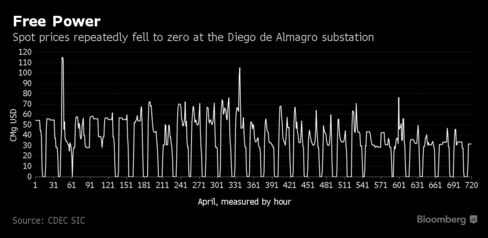
Spot prices reached zero in parts of the country on 113 days through April, a number that’s on track to beat last year’s total of 192 days, according to Chile’s central grid operator. While that may be good for consumers, it’s bad news for companies that own power plants struggling to generate revenue and developers seeking financing for new facilities.
Chile’s increasing energy demand, pushed by booming mining production and economic growth, has helped spur development of 29 solar farms supplying the central grid, with another 15 planned.
Further north, in the heart of the mining district, even more have been built. Now, economic growth is slowing as copper output stagnates amid a global glut, energy prices are slumping and those power plants are oversupplying regions that lack transmission lines to distribute the electricity elsewhere.
“Investors are losing money,” said Rafael Mateo, chief executive officer of Acciona SA’s energy unit, which is investing $343 million in a 247-megawatt project in the region that will be one of Latin America’s largest. “Growth was disordered. You can’t have so many developers in the same place.”
A key issue is that Chile has two main power networks, the central grid and the northern grid, which aren’t connected to each other. There are also areas within the grids that lack adequate transmission capacity.
That means one region can have too much power, driving down prices because the surplus can’t be delivered to other parts of the country, according to Carlos Barria, former chief of the government’s renewable-energy division and a professor at Pontifical Catholic University of Chile, in Santiago.
"Michelle Bachelet’s government has set the energy sector as a priority,” said Carlos Finat, president of the country’s renewable association, known as Acera. “But planning has been focused in the short term when it is necessary to have long term plans to solve these type of issues."
Inadequate Infrastructure
The government is working to address this issue, with plans to build a 3,000-kilometer (1,865-mile) transmission line to link the the two grids by 2017. It’s also developing a 753-kilometer line to address congestion on the northern parts of the central grid, the region where power surpluses are driving prices to zero.
“Chile has at least seven or eight points in the transmission lines that are collapsed and blocked, and we have an enormous challenge to bypass the choke points,” Energy Minister Maximo Pacheco said in an interview in Santiago. “When you embark on a path of growth and development like the one we’ve had, you obviously can see issues arising.”
Solar Growth
Solar capacity on Chile’s central power grid, known as SIC, has more than quadrupled to 770 megawatts since 2013. Much of that comes from the grid’s northern sections, the Atacama region that’s home to the copper industry. Total installed capacity increased 5 percent in the past year, with half coming from solar farms, according to the grid operator, Cdecsic. SIC supplies power to the regions where 90 percent of the country’s residential demand is located.
The country is expected to install almost 1.4 gigawatts of solar power this year, up from 371 megawatts in 2015, according to Bloomberg New Energy Finance.
When power companies aren’t giving away electricity, it’s cheap. At the Diego de Almagro substation in the Atacama region, for example, prices didn’t exceed $60 a megawatt-hour for most of March. That’s less than the $70 minimum price for companies that won long-term contracts to sell solar power in Chile’s energy auctions in October and March.
The issue may limit future development because the uncertain revenue means banks will be reluctant to finance new power plants, according to Rodrigo Violic, head of project finance at the Chilean lender Banco Bice. “It’s a big problem,” he said.
Solar ‘Surprise’
Salvatore Bernabei, head of Enel Green Power SpA’s operations in Chile, has 170 megawatts of capacity in operation and 300 megawatts under construction in the country. He wouldn’t say if his company has surplus power.
Bernabei, however, is adamant that change is needed. “The rapid development of renewables was a surprise and now we have to react quickly,” he said.
Until this is resolved, low prices will plague companies that own power plants, according to Jose Ignacio Escobar, general manager for Acciona’s Chile unit.
Wednesday, June 1, 2016
Thank you from Kathy Fernandez Rundle, Miami-Dade State Attorney
|
|
|


Subscribe to:
Posts (Atom)